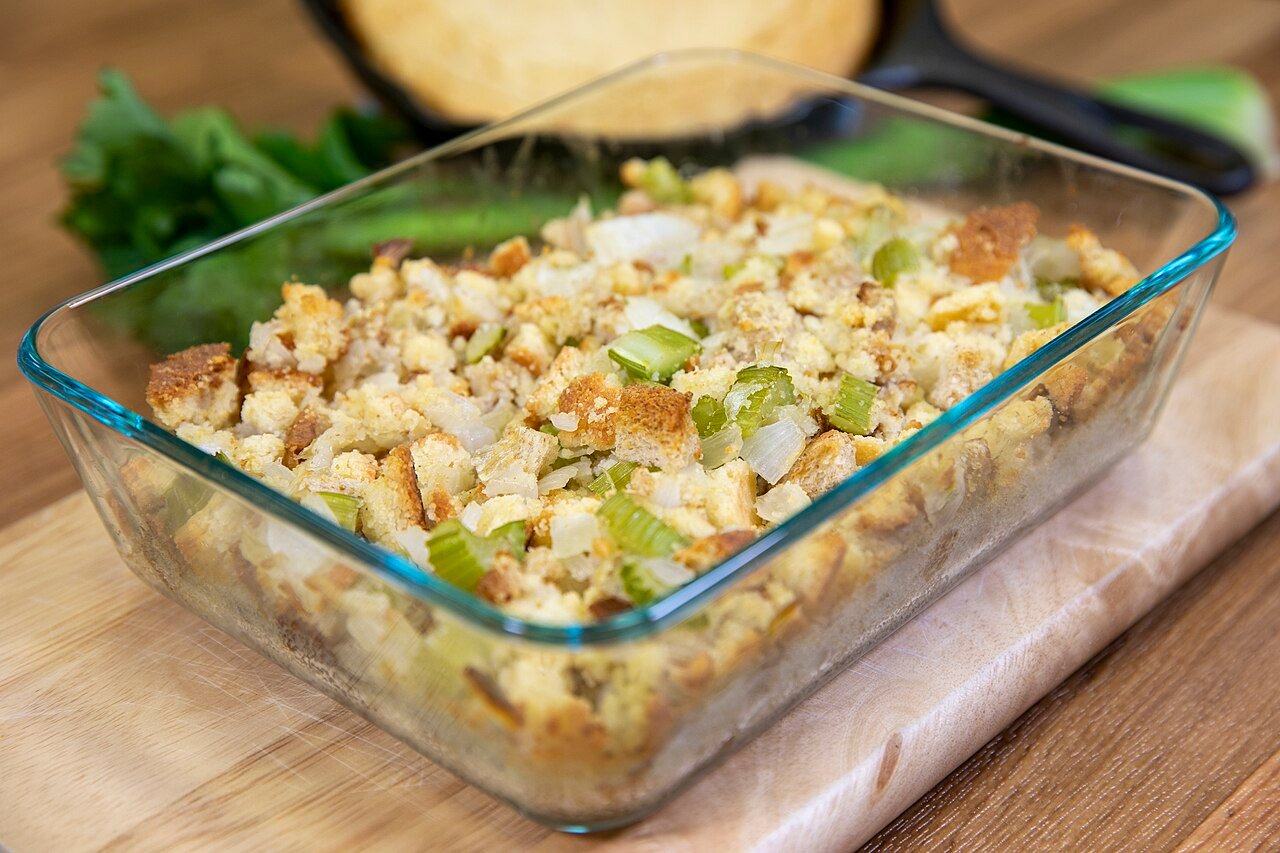
Ask a Southerner about Thanksgiving dressing and you will get an opinion before you finish the question. Cornbread dressing is not a side dish in my house — it is the dish. The turkey gets the compliments, the pie gets the photographs, but the dressing is what people quietly go back for, and it is the pan that comes back to the kitchen scraped clean.
If you grew up with white-bread stuffing from a box, cornbread dressing will surprise you. It is richer, more golden, more crumbly, and it tastes like the cornmeal it is made from. It is also forgiving. Once you understand the cornbread, the rest is just good stock, good seasoning, and patience.
Here is the classic recipe I make every year, the variations worth trying, and the mistakes that turn a great dressing into a soggy brick.
Dressing vs Stuffing: What’s the Difference?
People use the words interchangeably, but they are not the same thing — and the difference matters for both the recipe and the food safety.
Stuffing is cooked inside the bird. Dressing is baked separately in a pan. That is the whole distinction. Cornbread dressing is almost always a dressing: it bakes in a casserole dish, which means it gets a golden, crispy top and a moist center without ever going inside a turkey.
There are two practical reasons to bake it separately. First, the top gets crisp, and that contrast between crunchy edges and soft middle is the best part of the dish. Second, it is safer and simpler — dressing cooked inside a bird has to reach a safe temperature all the way through, which often means overcooking the turkey while you wait. Baking it in a pan takes that worry off the table entirely.
In the South, we call it dressing even when it is baked in a pan, and we call it cornbread dressing because the base is cornbread, not white bread. If someone at your table insists on calling it stuffing, let them — just make sure it comes out of the oven, not the bird.
The Cornbread Matters Most
Here is the truth about cornbread dressing: the dressing is only as good as the cornbread. Everything else — the stock, the sage, the celery — is seasoning. The cornbread is the dish.
Make your own, and make it the day before. Boxed cornbread mix works in a pinch, but it is usually sweet, and sweet cornbread makes sweet dressing. Southern dressing cornbread is savory: cornmeal, a little flour, baking powder, salt, an egg or two, and buttermilk. No sugar, or just a pinch if you must. Bake it in a cast-iron skillet if you have one — the crust it makes is the first layer of flavor.
If you have never baked cornbread from scratch, my no knead farmhouse bread guide will get you comfortable with the rhythm of it, and the sourdough bread beginners walkthrough covers the same patient, from-scratch approach — though for dressing, you want plain cornbread, not sourdough.
Let it go stale. This is the step people skip, and it is the step that matters most. Fresh cornbread is too soft — it turns to mush when the stock hits it. Day-old cornbread, left uncovered on the counter overnight or dried in a low oven for twenty minutes, holds its crumble. You want the pieces to stay distinct, not dissolve.
Crumble it by hand. Break the cornbread into rough, uneven pieces — some the size of peas, some the size of marbles. Uneven crumbs are the secret to good texture. Uniform crumbs make a uniform paste, and nobody wants to eat paste.
Classic Southern Cornbread Dressing
This is the base recipe. Master this one, and every variation below is just a change of a single ingredient.
Ingredients:
- 8 cups crumbled day-old cornbread (about one 9×13 pan of cornbread)
- 2 cups crumbled day-old biscuits or white bread (optional, but it lightens the texture)
- 1 large onion, diced fine
- 3 stalks celery, diced fine
- 1 stick (1/2 cup) butter
- 4 cups chicken or turkey stock, warm
- 3 eggs, beaten
- 2 teaspoons dried sage (or 1 tablespoon fresh, chopped)
- 1 teaspoon dried thyme
- 1 teaspoon salt, plus more to taste
- 1/2 teaspoon black pepper
Step 1: Sauté the vegetables. Melt the butter in a skillet over medium heat. Cook the onion and celery until soft and translucent, about eight minutes. Do not brown them — soft and sweet is what you want. This is the flavor base of the whole dish, so do not rush it.
Step 2: Combine the dry ingredients. Put the crumbled cornbread and biscuits in your largest bowl. Stir in the sage, thyme, salt, and pepper. Then stir in the sautéed onion and celery, butter and all.
Step 3: Add the wet ingredients. Pour in the warm stock a cup at a time, stirring gently. Then stir in the beaten eggs. You are looking for a texture like thick, wet sand — it should hold together when you squeeze a handful, but it should not be soupy. Start with three cups of stock and add the fourth only if the mixture still looks dry. Different cornbread absorbs differently, and this is where your judgment matters more than the recipe.
Step 4: Bake. Spoon the mixture into a buttered 9×13 baking dish and press it down lightly — not hard, just enough to even it out. Bake at 375°F for 40 to 45 minutes, until the top is golden brown and the edges are crisp. The center should be set, not jiggly.
Step 5: Rest before serving. Let it sit for ten minutes before you cut into it. It firms up as it cools slightly, and it slices cleanly instead of falling apart on the serving spoon.
📌 Pin this: The dressing is done when the edges pull slightly away from the dish and the top is deeply golden. If the top is still pale after 45 minutes, turn the oven up to 400°F for the last five minutes — that final blast is what makes the crust.
The Stock Is the Second Secret
Cornbread dressing lives or dies on its stock. Water makes bland dressing. Canned broth makes acceptable dressing. Homemade stock makes the kind of dressing people ask about.
If you have a turkey carcass or a chicken carcass, make stock the day before — it is mostly waiting, not working, and my homemade chicken stock guide walks through the whole process with the bones you already have. The stock from your Thanksgiving turkey neck and giblets is the traditional choice, and it is the one my family uses: simmer the neck and giblets while the turkey roasts, strain it, and you have exactly the stock this dressing wants.
No time for homemade? Use the best low-sodium store-bought stock you can find, and warm it with a few sprigs of thyme and a bay leaf for ten minutes before you pour it in. It is a small step that makes a real difference.
Variations Worth Trying
Once you have the classic down, these are the variations that actually earn their place on the table.
Sausage cornbread dressing: Brown a pound of breakfast sausage, drain it, and fold it into the mixture before baking. This is the heartiest version and the one the men in my family request by name. Sage sausage is the traditional choice.
Oyster dressing: A Louisiana classic. Fold in a pint of drained, chopped oysters with the wet ingredients. It sounds unusual if you have never had it, but the oysters melt into the dressing and add a richness that nothing else matches. If oysters are not your family’s thing, skip it — this one divides tables.
Apple and pecan dressing: Fold in one diced apple and a half cup of chopped toasted pecans. The apple adds a sweet-tart bite, the pecans add crunch, and the combination makes the dressing feel a little lighter next to all that gravy.
Vegetarian dressing: Use vegetable stock and skip the sausage. The recipe works exactly the same, and with good stock it is every bit as satisfying. This is the version I make when vegetarian family members are coming, and nobody at the table has ever missed the meat.
Common Mistakes (and How to Fix Them)
Mistake #1: Too much stock. This is the number one dressing failure. If the mixture looks like soup before it goes in the oven, it will come out like a brick. Add stock a cup at a time and stop when the mixture holds together. You can always add more; you cannot take it out.
Mistake #2: Fresh cornbread. Fresh cornbread dissolves. Day-old cornbread crumbles. If you forgot to make it the day before, cut fresh cornbread into cubes and dry it in a 250°F oven for twenty minutes. It is not as good as overnight staling, but it works.
Mistake #3: Not enough seasoning. Cornbread is bland by itself, and it needs a confident hand with salt and sage. Taste the mixture before you add the eggs — it should taste slightly over-seasoned, because baking mellows the flavors. If it tastes flat now, it will taste flat later.
Mistake #4: Packing it down too hard. Press the dressing into the dish gently. If you compress it, the steam cannot escape, the center stays gummy, and the top never crisps. Light hands, always.
Mistake #5: Serving it straight from the oven. It needs ten minutes to set. Cut into it hot and it falls apart. Wait, and it slices like a dream.
Make-Ahead and Reheating
Cornbread dressing is one of the best make-ahead dishes on the Thanksgiving menu, because the whole thing can be assembled the day before.
Assemble ahead: Mix everything, spoon it into the baking dish, cover tightly, and refrigerate overnight. The next day, let it sit on the counter for thirty minutes while the oven preheats, then bake as usual — add five extra minutes since it is starting cold.
Bake ahead: Bake it fully the day before, cool it, cover, and refrigerate. Reheat covered with foil at 350°F for twenty-five minutes, then uncover for the last ten minutes to re-crisp the top. A splash of warm stock over the top before reheating keeps it moist.
Freeze it: Baked dressing freezes well for up to three months. Cool it completely, wrap tightly, and thaw overnight in the fridge before reheating. The texture is nearly as good as fresh, which makes it a wonderful dish to send home with guests in takeaway containers.
FAQ: Cornbread Dressing Recipes
Can I use boxed cornbread mix?
You can, but check the sugar — most mixes are sweet, and sweet cornbread makes sweet dressing. If boxed mix is what you have, use a savory variety and skip any added sugar in the recipe.
Do I need biscuits or white bread in the mix?
No, it is optional. All-cornbread dressing is denser and more intensely cornbread-flavored. Adding biscuits lightens it. I use the two-to-one ratio in the recipe above, but either way works.
How do I know when the dressing is done?
The top should be golden brown, the edges should be crisp and pulling slightly away from the dish, and the center should be set rather than jiggly. A knife inserted in the center should come out hot and mostly clean.
Can I make cornbread dressing gluten-free?
Yes — use a gluten-free cornbread recipe and skip the biscuits, or use gluten-free bread. The texture is nearly identical, since the cornbread is doing most of the work.
What is the difference between cornbread dressing and cornbread stuffing?
Nothing in the recipe — only where it cooks. Baked in a pan, it is dressing. Cooked inside the bird, it is stuffing. Bake it in a pan for the crisp top and the simpler food safety.
Conclusion
Cornbread dressing is the dish that makes Thanksgiving taste like Thanksgiving in my house. It is not complicated — day-old cornbread, good stock, sage, and an oven — but it rewards the cook who respects the details: stale the bread, season boldly, and do not drown it in stock. Get those three things right and the dressing will be the pan that comes back empty.
Your action step this week: Bake the cornbread the day before Thanksgiving and leave it uncovered on the counter overnight. Mix the dressing in the morning, bake it while the turkey rests, and serve it with the golden top facing up. It is the easiest “from scratch” dish on the table, and it is the one your family will remember.

