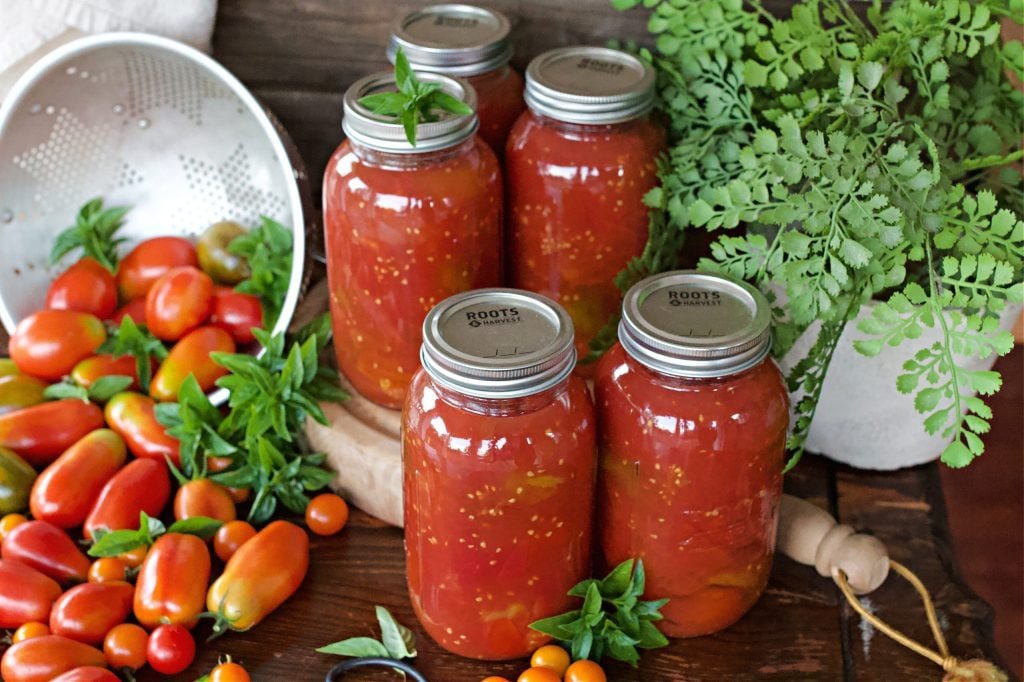
Every October, the same thing happens on our farm: the vines are tired, the frost is coming, and there’s a counter full of tomatoes that need a decision. Eat them, freeze them, or can them. Canning wins — because nothing tastes like August in the middle of February quite like a jar of tomatoes you put up yourself.
If you’ve never canned tomatoes, this is the guide to start with. We’ll cover the water-bath method step by step, the dead-simple peel trick, the one acidification rule you must never skip, and the yield math so you know exactly how many jars to wash. If you’re brand new to canning in general, read our https://amesfamilyfarm.com/water-bath-canning-for-beginners/ guide first — the safety rules there apply to everything here.
Why Tomatoes Get Special Treatment
Tomatoes sit right on the borderline between high-acid and low-acid foods. Old-fashioned varieties were reliably acidic, but many modern varieties — especially the sweet, low-acid types everyone loves fresh — can test above pH 4.6. That’s the line where botulism becomes a concern.
The USDA’s answer is simple and non-negotiable: acidify every jar of canned tomatoes. Add bottled lemon juice or citric acid to each jar before processing. This isn’t optional, and it’s not a flavor choice — it’s the safety step that makes water-bath canning tomatoes possible. More on the exact amounts below.
The 60-Second Peel Trick
Peeling twenty pounds of tomatoes by hand sounds miserable. This trick makes it fun:
1. Bring a large pot of water to a rolling boil. Fill a big bowl with ice water and set it nearby.
2. Cut a small X in the bottom of each tomato (opposite the stem end).
3. Drop tomatoes into the boiling water in batches — don’t crowd the pot.
4. After 30–60 seconds, when the skins start to split and curl at the X, fish them out with a slotted spoon.
5. Plunge them straight into the ice water. The skins will slip off with your fingers like a jacket.
Core them as you go, and you’re ready to pack. The whole bushel takes less time than you’d think, especially with a second pair of hands and a podcast.
Yield Math: Bushel to Quarts
Before you start, wash enough jars. Here’s the math:
- 1 bushel of tomatoes = about 53 pounds.
- 1 quart jar holds roughly 2.5–3.5 pounds of prepared tomatoes (about 3 pounds is a good planning number).
- So one bushel yields roughly 15–20 quarts (plan for 18 quarts to be safe).
- Pints: double the quart count — a bushel makes about 30–36 pints.
For most families, a half-bushel (about 25 pounds) is a perfect first canning session: roughly 8–10 quarts, one manageable afternoon. Core and peel as you go, and keep a bowl for the “rejects” — split or overripe tomatoes are perfect for sauce.
What You Need
- Water bath canner with rack, jar lifter, funnel, bubble remover (full list in our https://amesfamilyfarm.com/water-bath-canning-for-beginners/ equipment guide)
- Quart or pint mason jars with new lids and rings
- Bottled lemon juice or citric acid (not fresh-squeezed — bottled has standardized acidity)
- Canning or pickling salt (optional, 1 teaspoon per quart for flavor — never table salt with anti-caking agents)
- Tomatoes: paste types (Roma, San Marzano) for sauce; any ripe, unblemished variety for whole/halved
How to Can Tomatoes: Step by Step (Hot Pack)
Hot pack — heating the tomatoes before jarring — is the recommended method. It removes air, shrinks the tomatoes so you fit more in each jar, and gives you a better seal.
1. Prep the canner. Place the rack in your canner, add jars, fill with water to 1 inch over the jars, and bring to a simmer (180°F). Wash lids and rings in hot, soapy water.
2. Peel, core, and heat. Peel your tomatoes with the trick above, core them, and cut into halves or quarters. Place in a large pot and bring to a boil, stirring to prevent sticking. Boil gently for 5 minutes. Keep the pot at a simmer while you fill jars — you want the tomatoes hot going in.
3. Acidify each jar. This is the rule: add 2 tablespoons of bottled lemon juice per quart or 1 tablespoon per pint. Alternatively, use 1/2 teaspoon citric acid per quart or 1/4 teaspoon per pint. Add it straight to the empty hot jar before the tomatoes. If you like, add 1 teaspoon canning salt per quart for flavor.
4. Pack the jars. Ladle hot tomatoes into the hot jars, pressing gently to release air. Leave 1/2 inch of headspace. Add hot tomato juice or boiling water to cover, maintaining that 1/2 inch headspace. Run your bubble remover around the inside to release trapped air.
5. Wipe, lid, and ring. Wipe rims with a clean, damp cloth. Center new lids and screw rings on fingertip-tight.
6. Process. Lower jars into the canner, ensuring 1–2 inches of water over the tops. Cover, bring to a full rolling boil, and start timing: pints: 40 minutes; quarts: 45 minutes at 0–1,000 feet. Add altitude time: +5 minutes at 1,001–3,000 ft, +10 at 3,001–6,000 ft, +15 at 6,001–8,000 ft, +20 above 8,000 ft.
7. Cool and check. Turn off heat, rest jars 5 minutes in the canner, then lift onto a towel-lined counter. Cool undisturbed 12–24 hours. Check seals (lids concave, no flex), label, date, and store rings-off in a cool, dark place.
Raw pack option: You can also pack raw peeled tomatoes tightly into hot jars with the same acidification, then cover with boiling water — process pints 40 minutes, quarts 45 minutes (same times). Hot pack gives better quality and fewer floaters, so it’s worth the extra pot.
Common Mistakes
Skipping the lemon juice because “my tomatoes taste acidic.” Taste tells you nothing about pH. Modern varieties vary wildly. Acidify every jar, every time — no exceptions.
Using fresh lemon juice instead of bottled. Fresh lemons vary in acidity from fruit to fruit. Bottled lemon juice is standardized, which is why every tested recipe specifies it.
Adding flour, cornstarch, or extra vegetables to “thicken” the jars. Never add thickeners or un-tested ingredients to canned tomatoes — they change how heat penetrates the jar. Thicken your sauce when you open the jar, not before you seal it.
Canning overripe or frost-damaged tomatoes. Use only firm, ripe, unblemished fruit. Overripe tomatoes are lower in acid and higher in spoilage risk. The mushy ones become today’s sauce, not this winter’s jars.
Forgetting altitude. If you’re canning at 4,000 feet with sea-level times, you’re under-processing. Know your elevation and add the minutes.
FAQ
Can I water-bath can tomatoes, or do I need a pressure canner?
Properly acidified tomatoes (bottled lemon juice or citric acid in every jar) are safe to water-bath. Plain tomatoes with no added acid are not — they’d need pressure canning. When in doubt, acidify and water-bath per tested times.
How long do canned tomatoes last?
Up to one year for best quality, stored cool and dark. After opening, refrigerate and use within a week.
Why is there liquid at the top of my jars?
Some separation is normal, especially with raw pack. As long as the jar sealed and you processed for the full time, it’s fine — just shake before using.
Can I can cherry tomatoes?
Yes — halve or leave whole, peel if you like (the boiling-water trick works on cherries too, though it’s fiddly). Same acidification and processing times apply.
My jars didn’t seal. Now what?
Refrigerate unsealed jars and use within a week, or reprocess within 24 hours with new lids for the full processing time.
Conclusion: Don’t Let the Last Batch Go to Waste
That final fall harvest — the one racing the frost — is the most satisfying canning session of the year. A bushel of tomatoes becomes eighteen quarts of summer, lined up on the shelf like money in the bank. Every jar is a pasta sauce, a chili, a soup that starts with something you grew.
Canning tomatoes is also the gateway skill of the homestead kitchen. Master it, and you’re ready for pickles, jams, applesauce — and eventually the pressure canner, where you can put up https://amesfamilyfarm.com/homemade-chicken-stock/ and vegetables too.
This weekend: grab that last batch before the frost does. Peel, acidify, process, and listen for the pings. February-you says thanks.